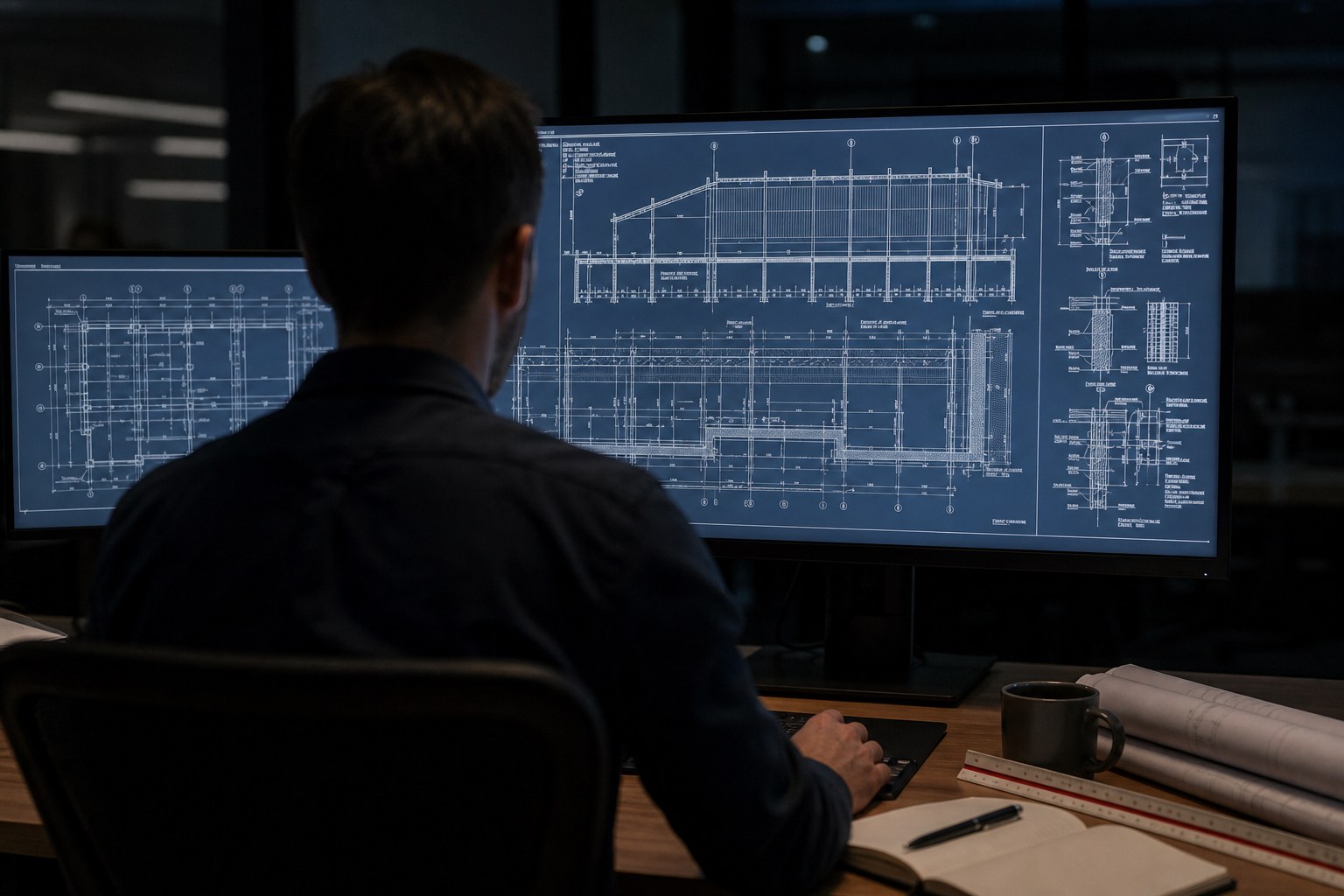
Design & engineering

Temporary Works Design and Design Checking

Practical engineering solutions developed around construction sequence, site constraints, available information and implementation risk.

Design and checking that stays buildable on site

We support contractors and project teams with temporary works design, assessment and design checking for project-specific requirements. The service begins with a clear design brief and agreed design category, interfaces, assumptions, deliverables and required date.

Our focus is not only whether a scheme calculates, but whether it can be safely communicated, installed, inspected, used and removed within the intended construction sequence.

Temporary works design and engineering review

Design categories

Design categories and when an independent check is required

Every temporary works design is assigned a category, and that category determines who is allowed to check it. Getting this wrong is one of the most common findings in a temporary works audit — usually because a scheme was categorised too low, and the check was carried out by someone who was not sufficiently independent of the designer.

The categories below reflect common practice under BS 5975. The category for any specific scheme is set by your temporary works procedure and the designer, taking account of complexity, ground conditions, loading and the consequences of failure.

Category 0

Restricted design

Typical examples

Standard solutions applied to standard situations — for example proprietary equipment used strictly within the supplier’s published tables and limits.

Who checks it

Checked by another member of the design team. The checker may have been involved in the wider project but not in producing the design itself.

Category 1

Simple design

Typical examples

Straightforward schemes such as limited-height falsework, simple formwork, basic edge protection support or simple excavation support in known ground.

Who checks it

Checked by an individual not involved in the design. The checker may come from the same organisation as the designer.

Category 2

Complex or non-standard design

Typical examples

Complex falsework, heavier propping and backpropping schemes, ground anchors, temporary stability schemes and non-standard excavation support.

Who checks it

Checked by an individual from a separate team within the same organisation, with no involvement in the original design.

Category 3

Complex or innovative design

Typical examples

Façade retention, complex demolition support, novel or first-of-a-kind schemes, and temporary works where failure would carry severe consequences.

Who checks it

Checked by an individual from a separate organisation, fully independent of the designer and the design organisation.

We provide independent design checking at the level appropriate to the category, scoped separately from originating design where genuine independence is required. If you are unsure which category a scheme falls into, send the design brief and we will advise before any work is committed.

See how audits test this

Design process

How Our Design Support Works

Open capability overview for what we provide, with clear points for when to engage design or design-checking support.

Design brief review and clarification

Temporary works design and calculations

Design risk identification and residual-risk communication

Independent design checking appropriate to the design category

Assessment of existing structures for temporary loading

Backpropping and load-distribution assessments

Construction-sequence and temporary-stability advice

Design change review and revised issue control

Design check certificates and supporting documentation

Frequently asked questions

What temporary works design services do you provide?

Design brief review, temporary works design and calculations, design risk identification, independent design checking appropriate to the design category, temporary loading assessments, backpropping advice and design change review.

What information is required for a design enquiry?

Project location, description of the temporary works, relevant drawings, loads or construction sequence information, client procedure requirements and the design category if known. Incomplete information can still be discussed; we will identify gaps.

Do you provide independent design checking?

Yes. Independent design checking can be provided at a level appropriate to the design category and client arrangements. Checking is scoped separately from originating design where independence is required.

How are fees and timescales confirmed?

After reviewing the available information we confirm assumptions, deliverables, programme and fee. Urgent assessments can often be prioritised where information is complete enough to proceed safely.

Request a Design Fee Proposal

Send the design brief, drawings, loads, sequence, programme and available structural information. We will confirm the scope, information requirements, programme and fee.

Prefer to talk it through first? Contact our design team.

Discuss your requirements

Provide your project or company details, required service, preferred date and any available information. We will confirm the appropriate scope, information required and fee.

Quick enquiry types